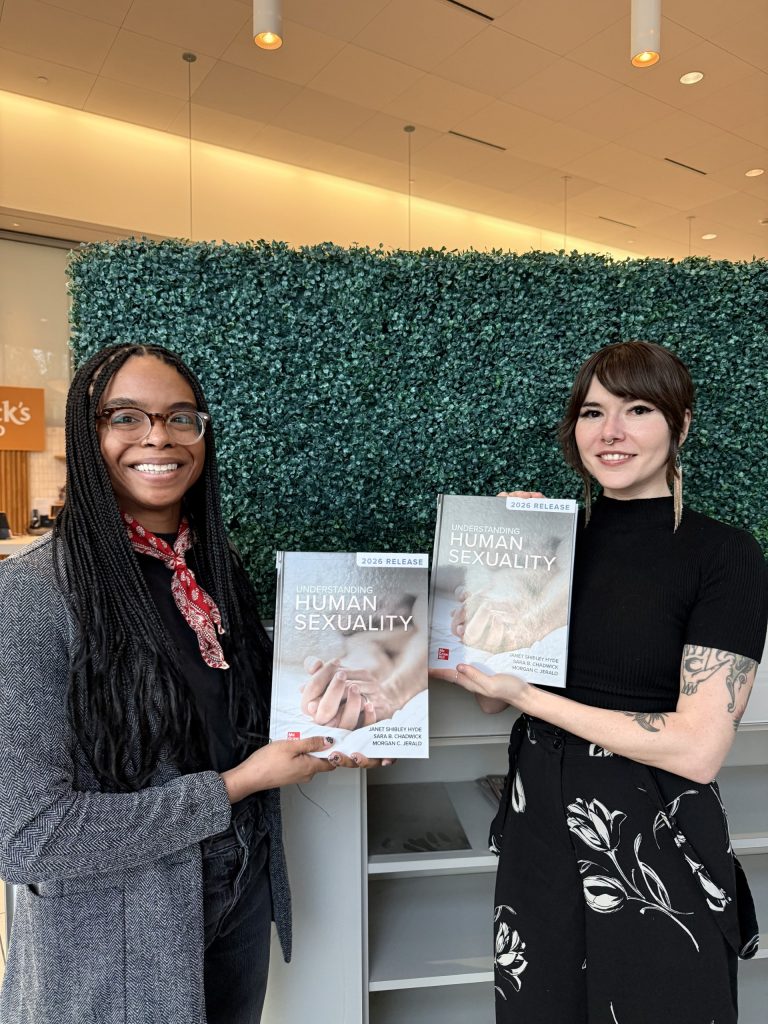
Chadwick and Jerald Bring Diversity to the Forefront in Understanding Human Sexuality
When Janet Shibley Hyde and John DeLamater, professors emeriti of UW–Madison, first published their textbook on human sexuality in 1979, it gave generations of students their first look at the science of sexuality. More than four decades later, two Institute for Diversity Science affiliates have taken up that work as new co-authors with Dr. Hyde for the new edition of Understanding Human Sexuality: Sara Chadwick, Assistant Professor of Gender & Women’s Studies, and Morgan Jerald, Assistant Professor of Psychology.
Both bring a diversity science lens to the project. Chadwick, a feminist scholar, studies “gray-area” sexual coercion and dating abuse that fall outside standard definitions of violence, including how these experiences vary by gender and sexual identity and contribute to health disparities. Jerald, a social psychologist, studies how racialized and gendered stereotypes, sexual objectification, and discrimination shape the mental, physical, and sexual health of Black women and girls, as well as their sexual agency and sense of belonging. Together, their research reflects the Institute’s commitment to understanding how identity and inequality shape people’s lives.
That focus guided their revision. Chadwick and Jerald combed through recent research to update the book’s coverage of new laws, social shifts, terminology, statistics, and treatments, from sexual orientation to contraception to coercion, so that the textbook better reflects the full range of people it describes.
“We wanted this edition to reflect the current science, including a more expansive understanding of how social identities (e.g., gender, sexual identity, race/ethnicity) and broader social structures (e.g., norms, healthcare systems, culture) shape sexual experiences and health. Our goal is for all students to see themselves reflected in the research, while gaining knowledge that supports their own sexual health and fosters appreciation for sexual diversity,” Chadwick says.
The authors also wanted students to understand how sexuality research is done. The new edition asks readers to think critically about research methods, the evidence behind each finding, and whose experiences are represented in the data.
“Like much of social science, sexuality research has often focused on a fairly narrow slice of people, usually White, cisgender, heterosexual, and middle class. We hope students come away thinking critically about whose experiences are represented and how our understanding of sexuality might change if we included different perspectives,” Jerald says.
For both authors, the textbook brings the questions central to their research into the classroom. It reaches undergraduates who may be encountering these topics for the first time and introduces them to the kind of rigorous, inclusive science that the Institute for Diversity Science works to advance.
Reference: Hyde, J. S., DeLamater, J. D., Chadwick, S., & Jerald, M. (2026). Understanding human sexuality (16th ed.). McGraw Hill.